

































Whether your gas fireplace is new to you or has warmed the living room for many winters, doubts tend to creep in sooner or later. An odd smell, cloudy glass or a flame that looks different from last year is enough to make anyone wonder. For homeowners in Edmonton who typed “emergency gas fireplace repair”, this page offers calm, practical answers about gas fireplace repair, along with the safety steps every household with a gas appliance should know.
Can a gas fireplace run on either propane or natural gas?
The two fuels run at different pressures through different-sized parts, so a fireplace set up for one can use the other only after a proper conversion. Propane needs the higher pressure and smaller burner orifices, and not every model has a conversion kit. On the job, we look for the label stating which fuel the unit is set for and confirm it matches the supply. With propane, we also ask about the tank, the regulator and whether the supply has ever run empty, since air in the line can make relighting stubborn. Most repairs, such as cleaning a pilot or replacing a sensor, look much the same for both fuels.
Is black soot in a gas fireplace a sign of a problem?
Black soot on gas fireplace glass or logs means the gas is not burning cleanly, and it is worth having checked. The usual causes are logs that have shifted out of position, too much ember material over the burner, a dirty burner or an air setting that is out of balance. Flames that touch the logs or glass leave dark marks quickly. Because poor combustion can also raise carbon monoxide levels, stop using the fireplace until a technician has looked at it, and make sure your carbon monoxide alarms work. Avoid rearranging logs on your own unless the manual clearly shows how, since placement is specific to each model.
What stops a gas fireplace from turning on?
A gas fireplace usually refuses to light because of a power, signal or ignition problem rather than anything dramatic. Start with the safe checks: replace the batteries in the remote and, if your model has one, in the battery pack or receiver; confirm the wall switch is on; and make sure the home’s gas service is working by checking that another gas appliance lights. If the unit runs on household power, look at the breaker. Beyond that, the cause is often a dirty pilot, a worn sensor or an igniter that no longer sparks, and those parts belong to a qualified gas technician. If you smell gas at any point, leave and call the utility from outside.
Which gas fireplace problems need attention right away?
Gas smells, carbon monoxide alarms, flames outside the burner area, cracked or shattered glass, a loud bang at ignition and black soot that appears quickly all need attention right away. Other faults, such as a dead remote or a pilot that will not stay lit, are inconvenient rather than dangerous once the fireplace is off. For a gas smell or an alarm, get everyone outside first and call the gas utility or 911 from there. For the other urgent signs, switch the fireplace off and keep it off. People who search for “emergency gas fireplace repair” often have one of these in front of them, and safety comes before any repair.
How does a technician find the fault in your gas fireplace?
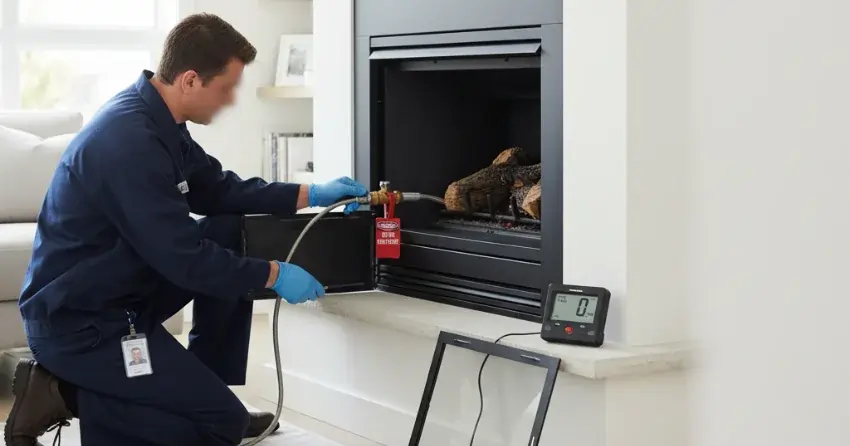
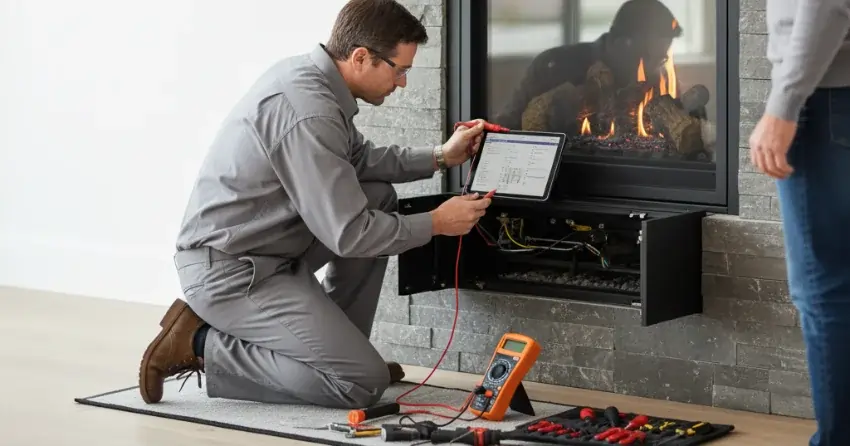
Repairing a gas fireplace starts with diagnosis, which is most of the job. We start by asking what the fireplace did before it failed, then watch it attempt to light while checking voltages, spark and gas flow at each stage. That sequence usually narrows the problem to one component fairly quickly. The culprits we replace most often are pilot sensors, igniters, battery packs and remote receivers, followed by valves and glass gaskets. We note the details from the rating plate so any part we order fits correctly. Once the repair is done, we relight, test the safety shutdown and leak-check every fitting we touched.
What affects the cost of gas fireplace service or repair?
The cost of gas fireplace work depends mainly on what the visit includes and which parts, if any, are needed. A routine cleaning and safety check is usually priced as a standard visit, while repairs add the part and the time to diagnose and install it. Parts vary widely: a battery pack or igniter is a small item, while a control valve or a full glass assembly is a larger one. Older or discontinued models can take longer to source parts for. Access matters too, such as a unit built into a tight space. Ask for a written quote that lists labor and parts separately.
Can a gas fireplace problem safely wait for a regular appointment?
Many can, as long as the fireplace stays off and the problem does not involve gas, exhaust or fire escaping the firebox. A remote that will not respond, a pilot that keeps going out, a noisy fan or cloudy glass are inconvenient but fine to leave until a booked visit, provided nobody keeps trying to relight or force the unit. Problems that cannot wait are a gas smell, a carbon monoxide alarm and anything that looks like smoke or flames where they should not be. If you found this page by searching for “emergency gas fireplace repair”, sort your situation into one of those two groups before deciding how quickly to call.
Do you need a carbon monoxide alarm near your gas fireplace?
A common guideline is to have working carbon monoxide alarms on every level of the home and outside each sleeping area, including the floor with the gas fireplace. Follow the alarm maker’s instructions for exact placement, since some advise against mounting one right beside fuel-burning appliances, where brief readings at startup can trigger false alarms. Many households test alarms monthly, replace batteries as directed and replace the whole unit when it reaches the end of the life printed on it. If an alarm sounds, get everyone outside into fresh air and call for help, and do not go back in until the cause is known.
How do you compare quotes for gas fireplace repair?
Compare the diagnosis behind each quote first, since most differences between repair quotes come down to it. One technician may quote a new valve because the fireplace will not light; another may have tested the sensor and found that a far smaller part is the real cause. When you line quotes up, ask each company how it reached its conclusion and what it measured. Check whether the visit fee is credited toward the repair, how long the part will take to arrive and whether the price covers the final leak check and test burn. The quote with the clearest reasoning is usually the one to trust.
Still have a question we did not cover?
Every home is a little different, so your situation may raise a question that is not on this page. Call us at (587) 853-6668 and describe what you have noticed. We can talk through the options for your gas fireplace and set up a visit anywhere around Edmonton if it makes sense.
