
































Reliable information gets surprisingly hard to find once you start reading about gas fireplaces online. Some advice is really written for wood-burning fireplaces, some covers a single brand and some glosses over safety entirely. For homeowners in Edmonton who looked up “fireplace remote control installation”, this page sticks to what applies to most gas units: how they work, what tends to wear out and what gas fireplace remote installation involves from the first phone call to the final test burn.
How does a gas fireplace work?
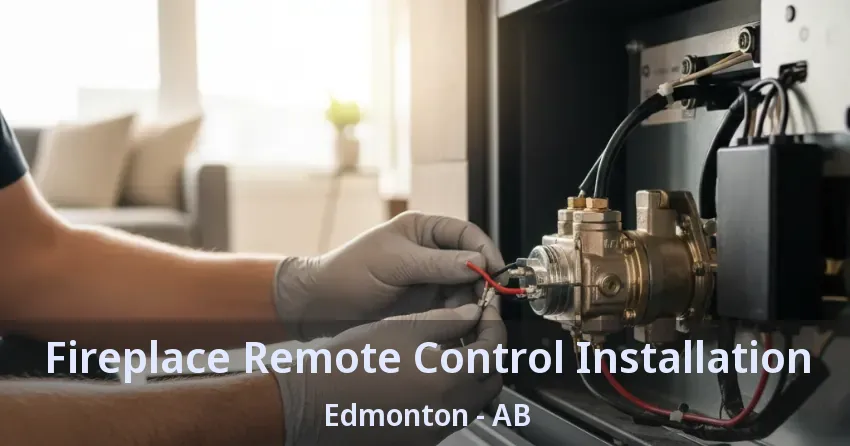
A gas fireplace works by sending a measured flow of gas to a burner, where a pilot flame or an electronic igniter lights it behind a glass front or screen. A control valve decides how much gas reaches the burner, and a safety sensor closes that valve if no flame is detected. On most models, a vent carries exhaust outdoors and brings in fresh air for combustion. Ceramic logs, stones or glass media sit on top of the burner to shape the flames. A wall switch, thermostat or remote tells the valve when to open, which is why the fire responds within seconds of the button being pressed.
Is a remote worth adding to a gas fireplace that has a wall switch?
For many households it is, mainly for comfort and control. A remote lets you light and adjust the fire from your seat, and thermostatic models keep the room at a set temperature instead of running the fire flat out. Some systems add timers or a child lock, which can be reassuring in busy homes. The wall switch usually stays as a backup. Whether it makes sense depends on how often you use the fireplace and whether your valve can accept a remote at all. A technician can confirm compatibility before any “fireplace remote control installation” work is booked, so you are not paying for a kit that will not fit.
Why does a fireplace remote suddenly stop responding?
Most remotes that stop working have a simple cause, usually power or pairing, and remote complaints are among the most frequent calls we get. Receivers are often tucked into the warm space under the firebox, and their batteries drain faster there than people expect. A handheld that was dropped, or fresh batteries inserted the wrong way round, can also lose its link. We check battery voltage at both ends, confirm the receiver switch setting and resynchronize the pair. If that fails, we test whether the valve responds when the receiver is bypassed, which tells us whether the fault lies in the remote system or in the fireplace itself. Sometimes a worn receiver simply needs replacing.
How is a gas fireplace checked for gas leaks?
A gas fireplace is checked for leaks by testing every accessible connection between the shutoff valve and the burner while the gas is on. Technicians commonly use an electronic gas detector that reacts to tiny amounts of gas, a bubble solution brushed onto fittings, or both. Bubbles growing at a joint point straight to the leak. The check covers the shutoff valve, the flexible connector, the control valve fittings and the pilot supply. Leaks are often too small to smell, which is one reason testing belongs in regular service. Homeowners should never try to tighten or seal gas fittings themselves.
What is included in a gas fireplace service?
A gas fireplace service typically includes cleaning, inspection and a test run. The technician shuts off the gas to the unit, removes the glass front and cleans the inside of the glass, the logs or media and the firebox. The burner and pilot are cleared of dust and debris, the logs go back in their correct positions and the glass gasket is checked. Ignition, safety sensors and controls are tested, gas connections are checked for leaks and the outdoor vent termination is looked at for blockages. Finally, the fireplace is run to confirm a clean, steady flame and a proper shutdown.
Why do prices for gas fireplace remote installation differ between homes?
Two things drive most of the price we give: time on site and parts. A clean, accessible fireplace that only needs routine service is quick. Diagnosis takes longer when a fault comes and goes, because we may need to run several cycles to catch it in the act. Parts are the other big variable, and they depend entirely on the make and model printed on the rating plate. Some components are widely stocked; others have to be ordered in. We would rather walk you through those factors before starting than surprise anyone afterward, so we ask about the fireplace and its symptoms first.
What should you find out about your fireplace before a remote installation?
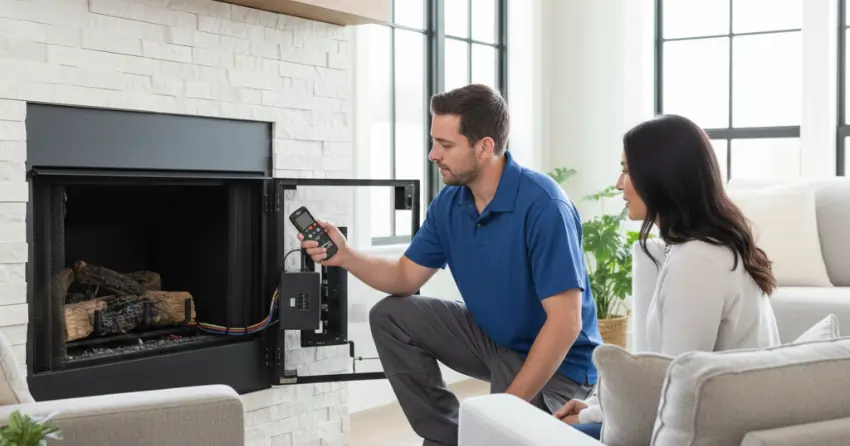
Find out the make and model, how the fireplace lights and whether there is an outlet close by, since those details decide which kit will fit. The label with the make and model is usually tucked behind the lower louver or attached by a small chain, so photograph it. Note whether the fireplace starts with a wall switch, a push-button igniter or a standing pilot. If an old receiver or remote is already installed, photograph that too. Share all of this when you book your “fireplace remote control installation” appointment, and mention any functions you hope to control, such as the fan or flame height, so compatibility can be checked first.
How do you get ready for your gas fireplace remote installation visit?
Preparing for a gas fireplace visit mostly means letting the unit cool and clearing space. Turn the fireplace off several hours ahead so the glass and metal are cool enough to handle. Move furniture, rugs, decorations and anything on the hearth back a few feet, and take fragile items off the mantel. Find the owner’s manual and the remote if you have them, and jot down any symptoms, such as odd smells or slow lighting. If the vent ends on an exterior wall or the roof, make sure the outdoor cap can be reached. Keep pets and young children in another room during the visit.
What should you do when a new fireplace remote will not connect?
Pairing a fireplace remote usually means pressing a learn or sync button on the receiver, then pressing a button on the handheld within a short window until the receiver signals that it has accepted the code. The exact steps differ between systems, so follow the manual for yours. Pairing may be needed after a battery change on some models, after a replacement remote arrives or after a power interruption. Make sure the receiver switch is set to remote and both units have fresh batteries first. If the receiver sits beside gas lines or behind a panel you are not comfortable removing, have a technician pair it.
Expecting guests this season?
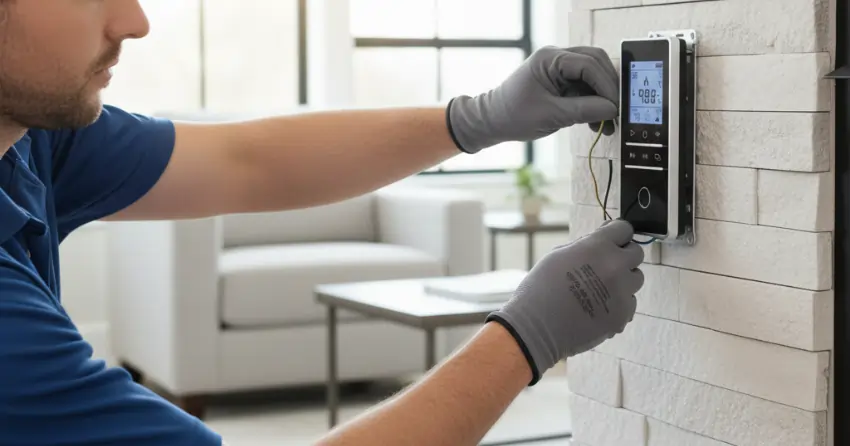
If your home will be busy with visitors, it helps to know everything is in order beforehand. Book gas fireplace remote installation a little ahead and enjoy the season without second thoughts. Reserve a time with Gas Fireplace Edmonton in Edmonton.
