
































Not every gas leak is dramatic. Some are small enough that the smell comes and goes, or only shows up near one appliance. Those still deserve to be taken seriously, because gas can collect in closed spaces. Homeowners in Edmonton who searched for “gas line specialist” will find straight answers here about gas line work, what a technician uses to track down a leak and what you should and should not do while you wait for help.
Why do restaurant kitchens need larger gas supply lines?
A commercial kitchen asks much more of its gas system than a home does. Fryers, ranges, griddles, ovens and steamers can all run at once, so the pipe, meter and regulators must be sized for the combined load rather than for a single stove. Equipment is often rolled out for cleaning, so flexible connectors with restraints are common. A main shut-off for the whole kitchen should be clearly marked and easy for staff to reach. Exhaust hoods, makeup air and fire-suppression systems tie into the picture, so gas changes in a business are planned and tested more formally than at home.
When should you call a specialist rather than an appliance repair technician?
Call an appliance technician when the fault is inside the appliance: a burner that will not light, a thermostat that fails or a control board that has quit. Call a gas line specialist when the question is about what feeds it: a smell or hiss at a connection, a corroded pipe, a stiff or leaking valve, a new run for an appliance or a line that needs capping. Sometimes both are needed, for example when a new range is installed. Tell each one what the other found, so the two visits fit together.
How is a gas line run to a grill, fire pit or pool heater?
Outdoor appliances can usually share the home’s supply when the existing system has enough capacity. The line commonly leaves the house or meter, runs along or into the ground and ends at a shut-off valve near the appliance. Buried sections are usually plastic pipe made for gas, with a steel riser where the line comes up, laid at a protected depth with a tracer wire or warning tape above it. A pool heater uses a lot of gas, so the main supply may need upgrading. Utility locate services should mark buried lines before anyone digs, and the finished run is pressure-tested.
What tools does a gas line specialist use?
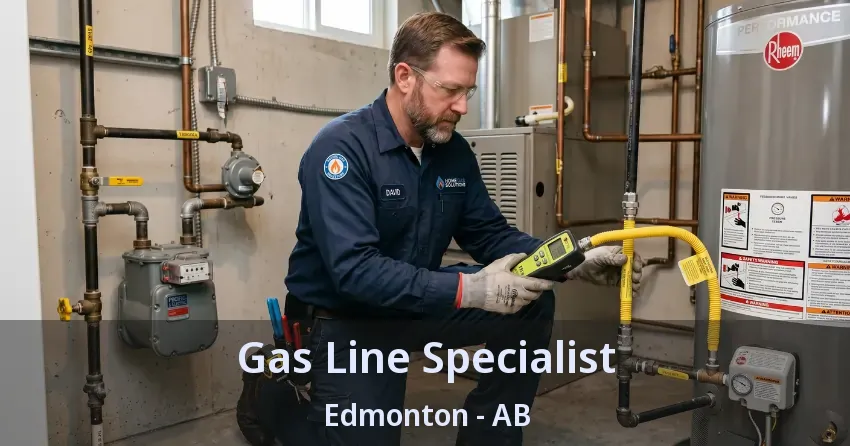
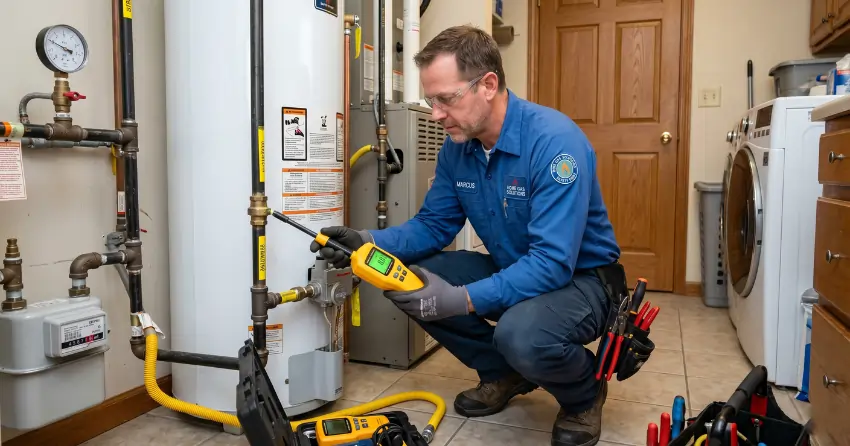
The essentials are testing and measuring tools more than wrenches. A combustible gas detector finds small leaks around joints, and a manometer or pressure gauge shows whether the piping holds pressure. Leak solution foams at an escaping point. For the work itself there are pipe cutters, threading tools, fitting tools for tubing and the sealants and fittings approved for each material. Many technicians also carry a camera or probe for tight spaces and a locating tool for buried lines. If someone arrives without a way to test the result, that is worth questioning before any pipe is touched.
What happens if a gas line is too small for the appliances on it?
Sizing is arithmetic, not guesswork. We list every appliance on the line with its rated input, add them up, measure the pipe from the meter to the farthest one and read the answer from sizing tables for that material and pressure. A long run needs wider pipe than a short one carrying the same load. The mistake we meet most often is a new appliance connected to a line sized for the old kitchen, so the flames sag whenever the furnace and the new fireplace run together. An extra half hour of calculation before the pipe goes in avoids that problem.
Can you repair or connect gas piping yourself?
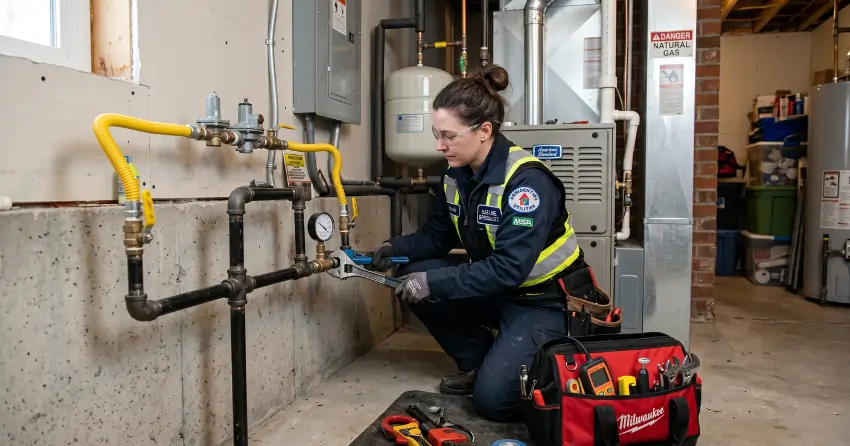
We get it: a leaky fitting looks like a ten-minute fix. The trouble is that gas leaks do not announce themselves, and the usual home remedies make them worse. Tape and putty are not rated for gas, over-tightening cracks fittings and a joint that holds at the stove may fail once the pressure comes back up. Without a detector and a gauge, there is no way to know the job is tight. What you can safely do is keep appliances accessible, test your alarms and call a technician at the first sign of trouble. The rest, from moving an appliance to restoring gas, is better left to someone equipped for it.
How can you tell an installer has planned the job properly?
Good questions bring out how well a job has been planned:
- How will the line be sized, and what load did you assume?
- Which materials will be used, and are they accepted in my area?
- Who applies for the permit and books the inspection?
- What does the price include: digging, wall repair, the pressure test, connecting the appliance?
- What happens if you find something unexpected in the walls or ground?
Clear, specific answers matter more than a low number; vague ones are a reason to keep looking.
What questions should you ask before gas line repair begins?
Ask for the reasoning behind the repair before any wrench turns. Why that fitting or section, and how was the leak confirmed? What happens if more corrosion turns up once the pipe is exposed? Is the pressure test included, and how long will the system be held under pressure? Who deals with the utility if the meter was locked? Answers to those questions also make quotes easy to compare, because they show whether one price covers locating, repairing, testing and restoring service while another covers only part of it.
What should a homeowner in Edmonton ask a gas company about local rules?
Local knowledge shows up in small things. A nearby team knows which paperwork your area expects, which questions inspectors tend to ask and how utility requests usually move around Edmonton. It also knows what the ground does here: frost depth, wet clay or rocky fill change how a yard line is laid. None of this makes a company good by itself, so ask any company, local or not, how it handles permits, testing and gas restoration. What nearness offers is that follow-up questions get answered by someone who knows your street.
Smell gas right now? Leave first
If you notice the rotten-egg smell of gas, get everyone outside without switching anything on or off, then call your gas utility or 911 from outside. Once the utility has made things safe, call Gas Fireplace Edmonton at (587) 853-6668 to plan the repair work in Edmonton.
