




























A reliable heater stretches the swimming season at both ends, which is why a failure feels so out of proportion to the size of the box. You may be dealing with a heater that will not fire, a puddle underneath or a gauge that looks wrong. For households in Edmonton typing “Hayward electric pool heater repair” into a search bar, this page gathers practical answers on electric pool heater repair, written the way a technician would explain them while standing beside your equipment pad.
What kinds of pool heater count as electric?
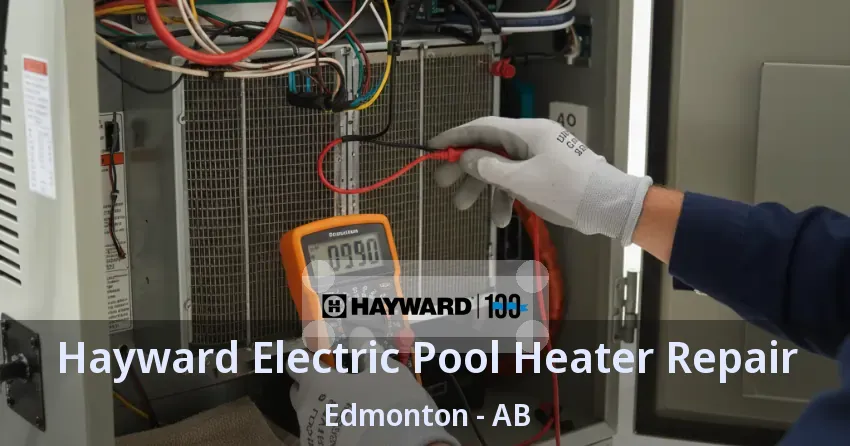
Two very different machines get called electric pool heaters. An electric resistance heater passes water over heating elements, much like a large water heater, and it draws a lot of power for the heat it makes, so it usually appears on spas and small pools. An electric heat pump uses power to run a fan and a compressor that pull warmth out of the outdoor air and pass it into the pool water, which is why it suits larger pools in mild weather. The type decides which parts fail and what a repair involves, so check the label before you describe the problem when you call about “Hayward electric pool heater repair”.
What causes a pool heater to run without heating?
If the heater is running yet the water barely warms, look at the conditions before the equipment. An uncovered pool in wind loses heat as fast as the heater adds it, and a thermostat set too low simply never calls for heat. Then consider the machine: a scaled heat exchanger, a bypass valve opened too far so most water skips the heater, or a heat pump with a blocked coil can all reduce output. Gas units may also be firing at reduced capacity from dirty burners. A technician can measure the temperature rise across the heater to see what it is really delivering.
How can you tell condensation from a real leak?
Some dripping is perfectly normal. A gas heater sweats when cool pool water first passes through a hot exchanger, and the moisture burns off as the unit warms. A heat pump pulls water out of the air as it cools it, just as an air conditioner does, so a steady trickle from its base while it runs is expected. Condensation is plain water, appears mostly at start-up or in humid air, and stops when the heater shuts down. A leak continues while the pump runs, may leave mineral stains or a green tint and tends to get worse over time.
What tests are used to find a pool heater fault?
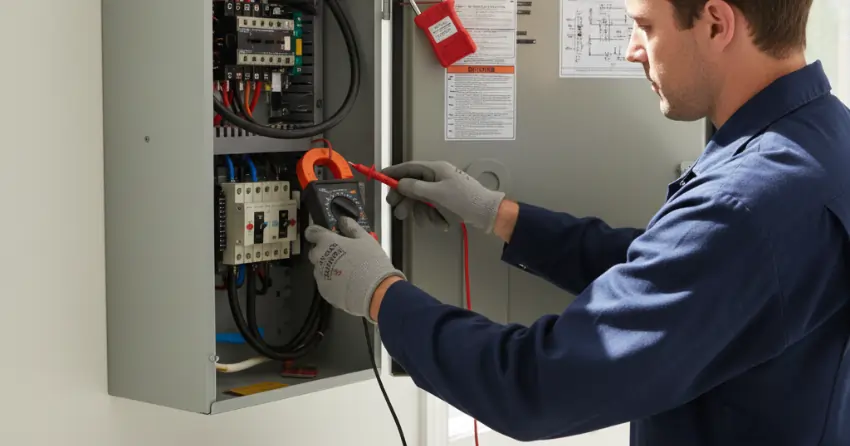
Good diagnosis is mostly elimination. We ask when the problem began, what changed and what the heater does or does not do. Then we measure rather than assume: voltage at the board, continuity through safety switches, water pressure on both sides of the unit, temperature rise across it. The reading that falls outside its expected range points to the faulty link. Replacing a part without a measurement behind it can cost you twice, once for the part and once for the repeat visit when the problem returns.
Which parts of an electric pool heat pump fail most often?
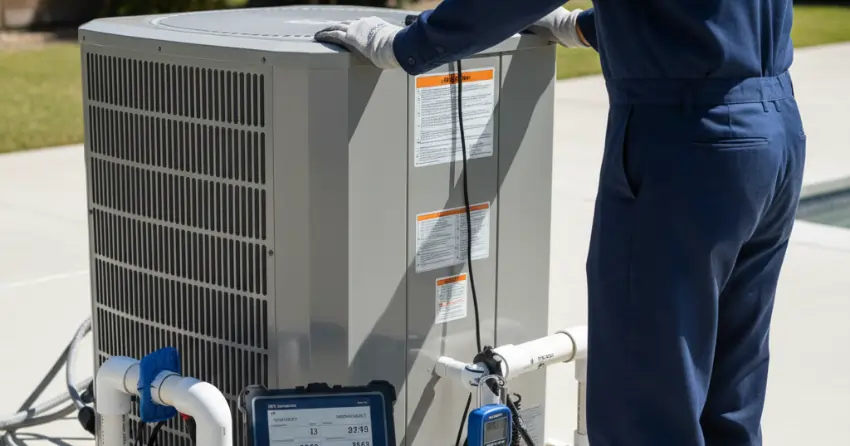
A heat pump has fewer moving parts than a gas heater, but several of them wear out. The fan motor and its capacitor are frequent culprits, since they work in heat, rain and dust. The compressor depends on a start capacitor and a contactor, and either can fail while the compressor itself is healthy. The air coil clogs with leaves, cottonwood and lawn clippings, and the water-side heat exchanger can scale over time. A flow switch, a temperature sensor or a control board can stop everything while the big parts are fine. A technician tests these in turn, which is why repair quotes vary so much from one fault to the next.
What does a pool heater heat exchanger leak mean?
Confirming the exchanger is the source takes care, because many drips are only fittings or headers. We isolate the heater, pressurize the water side and watch where moisture appears, then open the combustion area and inspect the tubes. If the exchanger is breached, the decision is financial and practical: is a replacement exchanger available for this model, how does its price compare with a new heater, and what shortened its life in the first place? Fixing that cause, usually water balance or freeze protection, is what keeps a second failure from following.
What is the defrost cycle on a heat pump pool heater?
Ice tells us about airflow and refrigerant. We check that the coil is clean, the fan spins freely and nothing blocks the space around the cabinet. We then verify that the defrost sensor reads correctly, because a bad sensor can leave the unit icing or defrosting at the wrong time. If those are sound and ice persists, the refrigerant charge may be low. Testing pressures and finding any leak requires gauges and a technician with the right tools and training, and topping up refrigerant without finding the leak is not a fix. Most heat pumps simply rest in very cold weather.
What happens during a pool heater service visit?
Think of it as a physical for your heater. We inspect, clean, measure and test, and then we tell you what we found. Typical steps are removing the access panels, checking connections for heat damage, clearing debris and insect nests, verifying water pressure and temperature rise, and watching the start-up sequence from beginning to end. If a part is close to failing, we point it out with the reason, so you can decide whether to replace it now or monitor it. A thorough visit leaves you knowing the heater’s condition, not just that it is running.
Why does water balance matter for a pool heater?
A heater is the one piece of equipment that heats the chemistry too, so it works as an early warning for water that is out of balance. Hot surfaces make scale form faster, and hot, acidic water corrodes faster. We often learn more from the inside of a heater than from the test strip. Bring your water test results when you book a visit. Keep in mind that shock treatments, very fresh fills and big swings in sanitizer all stress the exchanger, so slow, steady adjustments are kinder to it.
Pair good habits with a professional check
Simple routines at home go a long way, and a periodic visit catches what you cannot see. Together they keep your pool heater in steady shape year after year. Call (587) 853-6668 to plan the next check with Gas Fireplace Edmonton.
