




























Cool evenings and shoulder-season mornings are when a pool heater earns its place, and when weak spots tend to show. A flame that will not catch, a pump that struggles or a heat pump that seems to give up can end the swim before it starts. If “Hayward pool heater leaking water” matches what you are going through in Edmonton, these answers on pool heater leak repair offer a calm place to start, with safety guidance included.
What safety features does a pool heater have?
Most safety trouble comes from shortcuts, not from the heaters themselves. Jumpering a pressure switch, blocking the vent with a cover, storing paint or fuel near the cabinet or stacking boxes against a heat pump all create real hazards. Wiring and bonding matter too, because electricity and water share the same space. If you ever smell gas, leave the area and call your gas utility from a safe distance. Keeping the surroundings clear, scheduling regular service and acting early on warning signs go a long way toward keeping everything uneventful.
What does a pool heater heat exchanger do?
The heat exchanger is the part that transfers heat into the pool water, and it is the heart of every heater. In gas units it is a set of finned tubes sitting above the burners. In heat pumps it is a corrosion-resistant coil or tube bundle that the hot refrigerant gas passes around. In electric heaters the elements play the same role. Because pool water, chemicals and heat all meet here, it is the component most affected by poor water balance. Scale, corrosion and freezing can each damage it, so a heater often lives only as long as its exchanger does.
Can a small heater leak explain a pool that keeps losing water?
Sometimes, but not always. A drip at a heater fitting can lose a surprising amount of water over days, yet normal evaporation, splash-out and backwashing often explain a falling water level too. A simple bucket test can help sort it out, and the pattern of loss adds clues: a leak on the pressure side of the pump usually shows up only while the pump runs, and a crack in the heat exchanger may leak only under pressure. Look for wet ground, mineral crust or rust streaks around the equipment pad. Report what you find, including when the water level drops fastest, so the technician knows whether the heater is a suspect or only one of several.
How does a technician find the exact source of a heater leak?
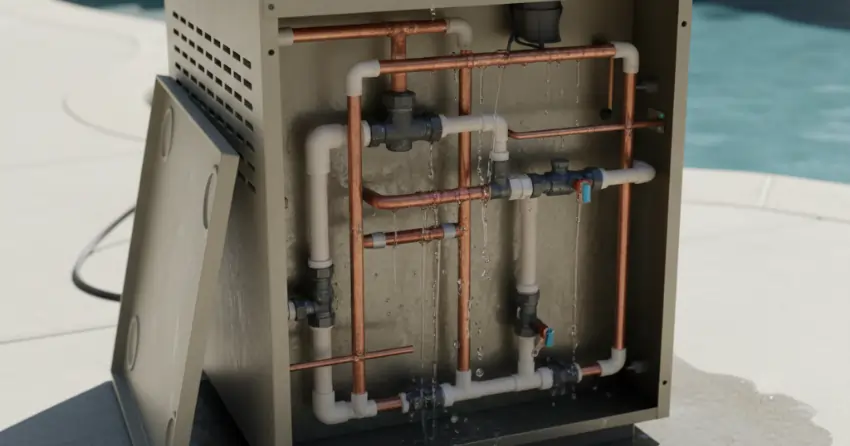
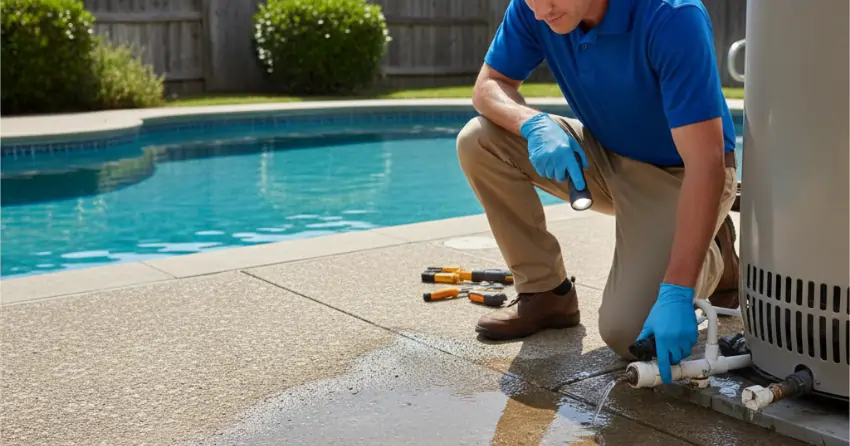
The technician first dries the area so new water stands out, then runs the pump with the heater off and watches where moisture appears. Comparing a dry start with a running pump separates a leak under pressure from condensation. Panels come off to follow the water upward to the header, the tube joints or the plumbing above, and a flashlight and paper towel help trace a slow seep. If the cause is hidden, the water side may be pressure-tested after isolating the heater with its valves. Photographs of the wet spot, taken before and after drying, help explain the findings to you and justify the repair that follows.
How is scale removed from a pool heater heat exchanger?
Scale is a slow problem with a quick give-away: the heater gets noisy and pool temperatures rise more slowly than before. We confirm it by checking the temperature rise, the pressure drop across the unit and, when the headers are off, the look of the tube interior. Cleaning is done with a proper descaling solution circulated in a controlled way, followed by a thorough rinse, because ordinary household acids can harm the metal. Afterward the pool’s calcium hardness, alkalinity and pH deserve testing, or the crust will simply rebuild over the next season.
How is a faulty pool heater tracked down?
Diagnosis follows the same path the heater follows when it starts. First comes power, then the control display and any stored codes. Next the technician confirms water flow and pressure, since those unlock the heat source. After that, the heat source itself is tested: igniter, flame signal and gas valve operation on gas units; compressor, fan and refrigerant side readings on heat pumps; element resistance and contactor operation on electric ones. Using a meter and the manufacturer’s sequence avoids the trap of swapping parts until something works.
Can a pool heater be repaired in one visit?
The honest answer is that diagnosis takes as long as it takes, and the repair itself is usually the shorter part. We arrive with common igniters, sensors, switches and gaskets, so straightforward faults are often finished before we leave. When the failed item is a control board, an exchanger or a model-specific part, we place the order and schedule a return once it arrives, and we tell you how long we expect to wait. Rushing a repair rarely helps, since a missed cause means a callback. A complete test at the end is part of the job, not an extra.
What can I check myself when my pool heater stops working?
Homeowners can safely check the basics. Confirm the pump is running and the water is circulating, and empty the skimmer and pump baskets. Make sure the filter pressure is normal, valves are open and the pool water level is high enough to keep the pump from drawing air. Check that the heater’s switch and breaker are on and that the thermostat is set above the current temperature. Look for obvious problems like debris, nests or a loose cover around the unit. If none of that helps, stop there. Gas, wiring, refrigerant and internal parts are for a technician.
When is it time to replace a pool heater instead of repairing it?
The decision rests on a few questions. How old is the heater, and how often has it needed repairs? What failed: an inexpensive part, or the heat exchanger or compressor that makes up much of the unit’s value? Are parts still available? Is it efficient and sized correctly for your pool? A single modest repair on a heater that otherwise runs well is usually sensible. Repeated failures, a leaking exchanger, heavy corrosion or a repair that approaches the cost of a new unit all point toward replacement.
Not sure where to start?
Start with whatever you noticed, even if it seems minor. A short description is enough for us to suggest the right kind of visit for your pool heater. Call (587) 853-6668 and the Gas Fireplace Edmonton team will guide you from there.
