




























Fire or electric current, flowing water and hot metal all meet inside a pool heater, so safety is built into how the work is done. That is worth remembering whenever you search for something like “Pentair pool heater leaking water”. The answers below, written for owners around Edmonton, explain pool heater leak repair and mark clearly where a homeowner can help, such as checking settings and keeping the area clear, and where a technician needs to take over.
What is the heat exchanger in a pool heater?
The heat exchanger is the part that transfers heat into the pool water, and it is the heart of every heater. In gas units it is a set of finned tubes sitting above the burners. In heat pumps it is a corrosion-resistant coil or tube bundle that the hot refrigerant gas passes around. In electric heaters the elements play the same role. Because pool water, chemicals and heat all meet here, it is the component most affected by poor water balance. Scale, corrosion and freezing can each damage it, so a heater often lives only as long as its exchanger does.
Can a small heater leak explain a pool that keeps losing water?
Sometimes, but not always. A drip at a heater fitting can lose a surprising amount of water over days, yet normal evaporation, splash-out and backwashing often explain a falling water level too. A simple bucket test can help sort it out, and the pattern of loss adds clues: a leak on the pressure side of the pump usually shows up only while the pump runs, and a crack in the heat exchanger may leak only under pressure. Look for wet ground, mineral crust or rust streaks around the equipment pad. Report what you find, including when the water level drops fastest, so the technician knows whether the heater is a suspect or only one of several.
How is a faulty pool heater tracked down?
Good diagnosis is mostly elimination. We ask when the problem began, what changed and what the heater does or does not do. Then we measure rather than assume: voltage at the board, continuity through safety switches, water pressure on both sides of the unit, temperature rise across it. The reading that falls outside its expected range points to the faulty link. Replacing a part without a measurement behind it can cost you twice, once for the part and once for the repeat visit when the problem returns.
How does a technician find the exact source of a heater leak?
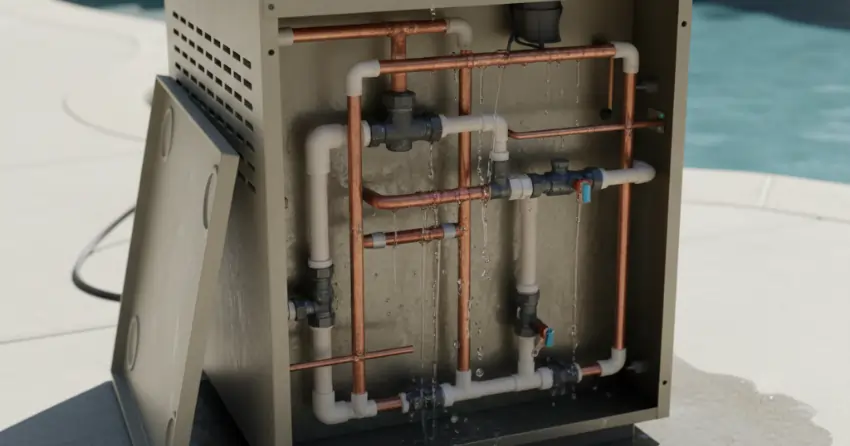
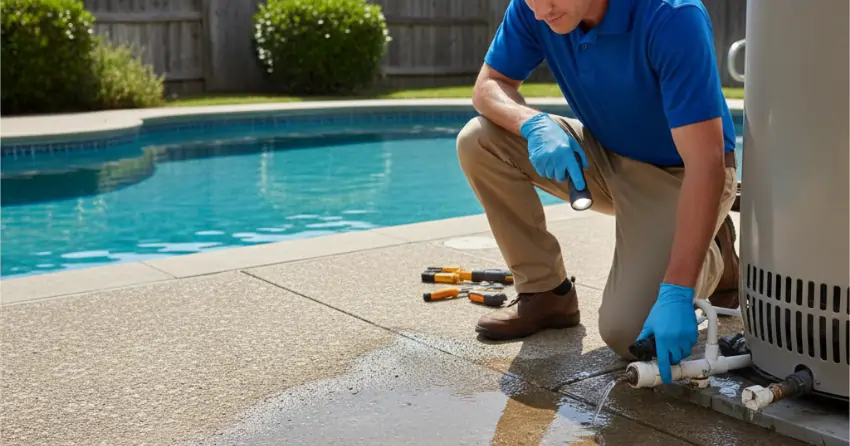
The technician first dries the area so new water stands out, then runs the pump with the heater off and watches where moisture appears. Comparing a dry start with a running pump separates a leak under pressure from condensation. Panels come off to follow the water upward to the header, the tube joints or the plumbing above, and a flashlight and paper towel help trace a slow seep. If the cause is hidden, the water side may be pressure-tested after isolating the heater with its valves. Photographs of the wet spot, taken before and after drying, help explain the findings to you and justify the repair that follows.
What does a pool heater heat exchanger leak mean?
Confirming the exchanger is the source takes care, because many drips are only fittings or headers. We isolate the heater, pressurize the water side and watch where moisture appears, then open the combustion area and inspect the tubes. If the exchanger is breached, the decision is financial and practical: is a replacement exchanger available for this model, how does its price compare with a new heater, and what shortened its life in the first place? Fixing that cause, usually water balance or freeze protection, is what keeps a second failure from following.
What does a pool heater service visit include?
Each visit opens with a discussion of the symptoms you have seen, followed by a look at the heater’s display, history and surroundings. The technician then checks power and water flow, inspects the cabinet for leaks, scale, corrosion and pests, and tests the controls and safety switches. On gas models that includes cleaning the burner area, testing ignition and flame signals and examining the venting. Heat pumps get coil, fan and electrical checks. The visit ends with a full heating cycle to confirm the unit lights, runs and stops as intended, and you receive a summary of findings.
How much time should you allow for pool heater repair?
Many pool heater repairs are finished in a single visit, particularly when the cause is something like a dirty flame sensor, a clogged flow path, a worn igniter or a tripped safety. Others depend on a part that has to be ordered, which stretches the job across two visits. Diagnosis itself takes time, because the technician needs to watch the heater run through its sequence and test each stage. Older or less common models may need extra searching for parts. Ask for an honest estimate of the visit itself and of any waiting for parts.
What should be kept clear around your pool heater?
It is easy to forget the heater when planning landscaping, fences or storage sheds, yet those additions often cause problems later. A hedge that has grown against a heat pump chokes its airflow. A fence built close to a gas heater can trap exhaust. Chemical containers stored on the pad release fumes that corrode metal. We walk around the unit when we visit and note anything that crowds it. If you are building a deck, wall or shed nearby, check the clearances first.
Which pool heater problems can a homeowner safely check?
Homeowners can safely check the basics. Confirm the pump is running and the water is circulating, and empty the skimmer and pump baskets. Make sure the filter pressure is normal, valves are open and the pool water level is high enough to keep the pump from drawing air. Check that the heater’s switch and breaker are on and that the thermostat is set above the current temperature. Look for obvious problems like debris, nests or a loose cover around the unit. If none of that helps, stop there. Gas, wiring, refrigerant and internal parts are for a technician.
What happens after you reach out
We confirm the details of your home, suggest a visit window and explain what pool heater leak repair will involve. On the day, the technician checks in before starting and walks you through the results at the end. Get started with a quote from Gas Fireplace Edmonton.
