




























A reliable heater stretches the swimming season at both ends, which is why a failure feels so out of proportion to the size of the box. You may be dealing with a heater that will not fire, a puddle underneath or a gauge that looks wrong. For households in Edmonton typing “Pentair pool heater service” into a search bar, this page gathers practical answers on pool heater service, written the way a technician would explain them while standing beside your equipment pad.
How do you pick the right heater capacity for a pool?
Heater size is measured in BTU output for gas and electric models, and in a similar capacity rating for heat pumps. The right number depends on pool surface area, how many degrees you want to raise the water, how much wind the pool sees and whether a cover is used. A pool heated only for weekends needs more capacity than one kept warm all season. An undersized heater runs constantly and still struggles, while an oversized one costs more up front and may cycle often. The rating plates and sizing charts supplied by manufacturers guide the choice, and a technician can apply them to your site.
Why does a pool heater depend on its heat exchanger?
Water goes in one end of the exchanger and out the other, picking up heat from the surface of the tubes. Anything that coats those tubes, such as mineral scale, makes the heater work harder and run hotter, while acidic water slowly eats the metal from the inside. Headers at each end connect the exchanger to your plumbing, and their gaskets or seals are a common place for seepage. When a technician says the exchanger has failed, it usually means a leak or severe blockage, and the repair depends on the model and the extent of the damage.
What happens at the end of a pool heater repair visit?
After a repair, the technician runs the heater through a complete cycle, because a part that works for a moment is not proof of a fix. That includes verifying power and flow, watching the start-up sequence, confirming the heat source engages and measuring the temperature rise. Safeties such as the pressure switch and high-limit are checked, and the cabinet is closed up and inspected for leaks once water is circulating. You should hear what failed, what was replaced and what to watch in the next few days.
What is a pool heater pressure switch?
The pressure switch, sometimes called a water pressure or flow switch, confirms that enough water is moving through the heater before heating is allowed. If the flow is too low, the switch stays open and the heater will not fire, or it shuts off partway through a cycle. Causes include a clogged filter, full baskets, a closed valve, a pump with trapped air or a worn impeller, and a heater whose bypass is set wrongly. Occasionally the switch itself fails or its small connection clogs with scale. Never jumper it, because it protects the exchanger from overheating.
How does a pool heater know the flame is lit?
When a heater lights for a second and drops out, the flame sensor is one of our first suspects. The board is designed to distrust any flame it cannot confirm, which keeps a faulty burner from running unattended. We measure the sensor’s signal while the burner runs and compare it with the manufacturer’s minimum. A low reading can come from residue on the rod, a loose connector, poor grounding of the burner or a flame that is not touching the rod properly. Cleaning, replacing or correcting the flame pattern restores the signal, and the heater should then complete its cycle normally.
Why does a heat exchanger develop a leak?
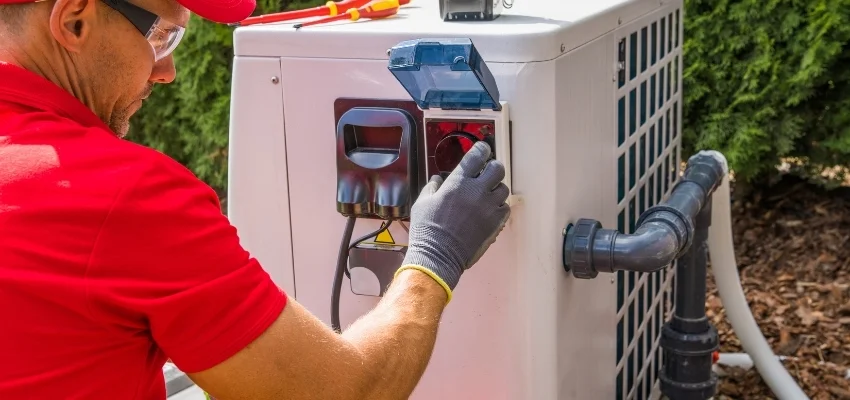
A leaking heat exchanger means water is escaping from the tubes themselves, usually through a pinhole, a crack or a failed joint. Common causes are corrosion from low pH or aggressive water, long-term scale that overheats the metal, freeze damage after a missed winterizing and ordinary fatigue. Signs include water inside the combustion chamber, rust-colored stains, steam at start-up and a heater that keeps losing efficiency. Patching tubes is rarely a lasting repair. Most exchangers are replaced as a unit, and your technician can tell you whether that makes sense for the age and model.
How does a technician check that a heater is performing well?
One of the most useful tests is the temperature rise, which compares the water temperature entering the heater with the temperature leaving it. Together with the water flow rate, it shows whether the heater is delivering the heat it should. The technician may also check gas pressure, watch the flame, read the pressure switch and high-limit behavior, and measure voltage and amperage on electric parts. A heater that runs without complaint but delivers less heat than designed is often scaled, fouled or starved of flow. Having these readings noted during pool heater service gives you a baseline to compare against next season.
Why does water balance matter for a pool heater?
A heater is the one piece of equipment that heats the chemistry too, so it works as an early warning for water that is out of balance. Hot surfaces make scale form faster, and hot, acidic water corrodes faster. We often learn more from the inside of a heater than from the test strip. Bring your water test results when you book a visit. Keep in mind that shock treatments, very fresh fills and big swings in sanitizer all stress the exchanger, so slow, steady adjustments are kinder to it.
Why does a pool heater need clear space and fresh air around it?
A gas heater pulls in air to burn its fuel and pushes exhaust out through the vent, so blocked airflow leads to poor combustion, soot and overheating. Electric and heat pump units need open space for airflow too. Keep the area around the cabinet free of stored items, pool toys, planters and chemical containers, and trim shrubs back. Do not wrap or enclose the heater without checking the clearances in its manual, and never stack anything on top of it. A technician checks that the air openings and exhaust path are open and that nothing flammable sits nearby. That simple housekeeping supports every visit for “Pentair pool heater service”.
Know the price before work starts
We agree on the scope and the price before any work begins, and we check in with you if we find something that changes the plan. Request your quote for pool heater service and see exactly what is included for your home.
