
































Opening day and closing day are the two moments in the year when a pool heater most deserves attention. Start-up reveals what the off season did to it, and shutdown protects it from the cold. Pool owners in Edmonton who searched for “pool heater leaking water” will find useful answers on pool heater leak repair that follow the calendar, including what to look for in spring, how to protect the unit in winter and what to do when something seems off in between.
How does a pool heater work?
Think of the heater as a heat exchanger with a safety system wrapped around it. Water comes in cool, gets warmed as it travels through tubes or chambers, and leaves a few degrees higher, so a pool changes temperature slowly as the same water makes many trips. Controls watch three things: whether water is flowing, how warm it is and whether the heat source is behaving. If any reading falls out of range, the unit pauses or locks out. That is why a heater can look dead when the real trouble is a clogged filter or a pump that is not moving water.
Can a small heater leak explain a pool that keeps losing water?
Sometimes, but not always. A drip at a heater fitting can lose a surprising amount of water over days, yet normal evaporation, splash-out and backwashing often explain a falling water level too. A simple bucket test can help sort it out, and the pattern of loss adds clues: a leak on the pressure side of the pump usually shows up only while the pump runs, and a crack in the heat exchanger may leak only under pressure. Look for wet ground, mineral crust or rust streaks around the equipment pad. Report what you find, including when the water level drops fastest, so the technician knows whether the heater is a suspect or only one of several.
Can a leaking pool heater damage the equipment around it?
Yes, and the damage grows the longer the leak continues. Constant moisture rusts the cabinet and burner tray, corrodes screws and brackets and leaves mineral crust on fittings. Water that reaches the control board, wiring or switches can cause shorts, flickering displays and faults that come and go. Dripping onto the pad can undermine its edges, and a wet area becomes a slipping hazard for anyone working near the equipment. Chemically treated pool water is harder on metals than plain water. Even a slow leak is worth reporting early. Keep the heater off until it is checked, since water and electricity do not mix.
Is it normal for a pool heater to drip while running?
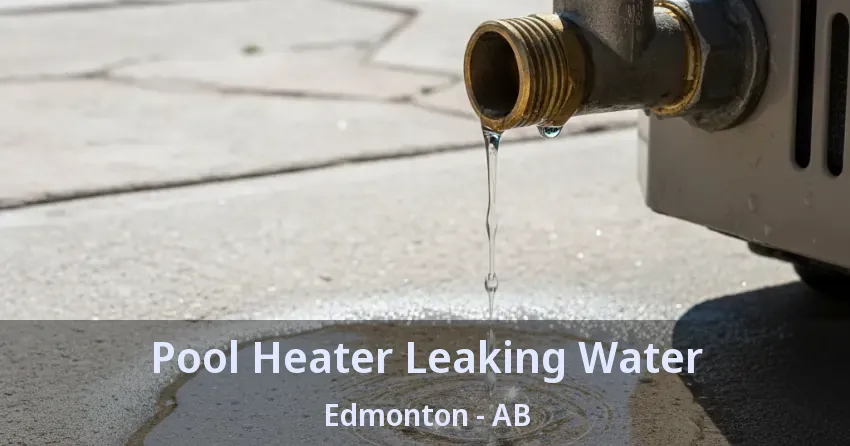
A simple test helps. Wipe the area dry, run the pump with the heater off, and watch for ten minutes. If water still appears, it is a leak in the plumbing or heater. If the area stays dry until the heater fires and then drips, you are likely looking at condensation. A heat pump’s condensate normally drains from a pan or port at the base, so a flow from that spot is no concern. Be wary of drips from the front of a gas unit or from fittings, since those are not condensation and deserve a visit.
Where does a leak from a pool heater usually come from?
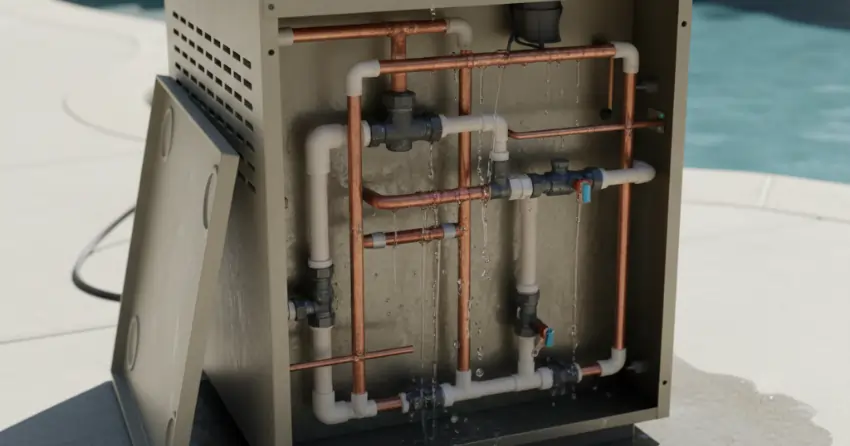
We trace a leak by working from the top down. Start dry: wipe the cabinet, then run the pump and watch where beads form. Unions and fittings at the inlet and outlet are the simplest culprits and are often fixed by renewing a seal. Seepage from the front or back of the exchanger points to header gaskets. Water from inside the combustion chamber or the base usually means the exchanger itself has a pinhole or crack. Photographs of the wet area and the time the leak appeared help us arrive with the right parts instead of making a second trip.
Why is water seeping from the header on a pool heater?
When we see moisture around a header, the first question is whether it is a gasket or the header itself. Gaskets are renewable parts: we release the header, clean the mating surfaces, fit new seals and tighten evenly in the right order. Cracked headers, whether polymer or metal, are replaced as an assembly. We also check the exchanger tubes for damage, because water that has been escaping for a while can attack them. Afterward, we pressure test the unit before returning it to service. Your part is to report any drips early and leave the unit off meanwhile.
What is a pool heater pressure switch?
Because the switch obeys water, the cure is often outside the heater. We read the filter pressure gauge, look at the pump basket, check that suction and return valves are fully open and confirm the pump primes properly. If the plumbing is healthy and flow is strong but the heater still reports low pressure, we test the switch and its tiny sensing line. A switch that is sticky, scaled or cracked gets replaced with the part specified for that model. Adjusting it by trial and error is not safe, so any change follows the manufacturer’s instructions.
How do you limit damage from a leaking pool heater before service?
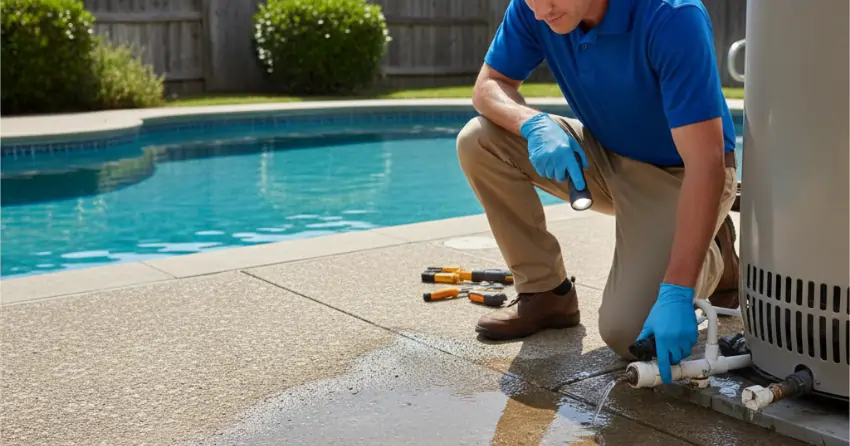
The goal is to stop the problem growing without creating new ones. Cutting power to the heater protects its electronics, and stopping the pump reduces the amount of water escaping. Please do not use the pool equipment as normal until we have looked. When you call, tell us how fast the water is leaking, whether it comes from the front, back or underneath and whether the heater was running. That helps us bring gaskets, unions or an exchanger as needed, and it spares you a second appointment.
How does pool water chemistry affect the heater?
A heater is the one piece of equipment that heats the chemistry too, so it works as an early warning for water that is out of balance. Hot surfaces make scale form faster, and hot, acidic water corrodes faster. We often learn more from the inside of a heater than from the test strip. Bring your water test results when you book a visit. Keep in mind that shock treatments, very fresh fills and big swings in sanitizer all stress the exchanger, so slow, steady adjustments are kinder to it.
Not sure what to do about your pool heater?
That is a common place to start. A short conversation usually sorts out what kind of visit makes sense, from a focused check to a full service. Reach Gas Fireplace Edmonton at (587) 853-6668 and we will give you a straight answer for your home in Edmonton.
