

































Pool heaters work quietly out of sight for most of the year, which makes it easy to forget they contain burners or heating elements, pressure switches, sensors and a heat exchanger that all have to cooperate. When one of them does not, owners in Edmonton often begin with a search such as “pool heater not turning on”. The questions below cover pool heater repair in plain terms, with the safety points that matter whenever gas, electricity and water share the same cabinet.
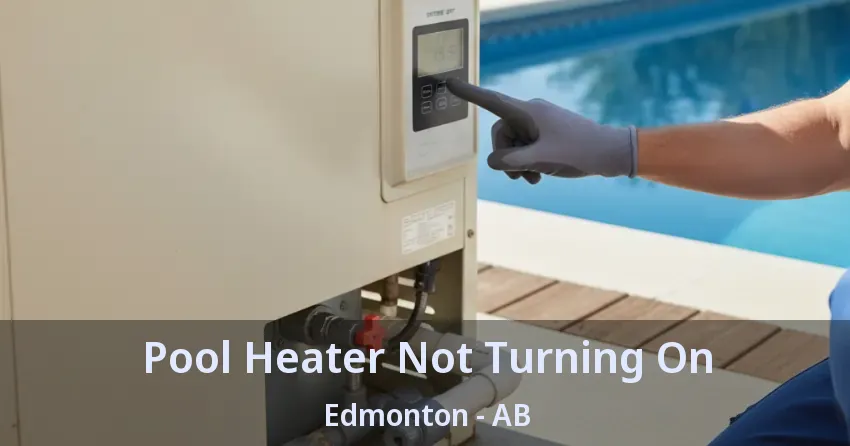
What makes a pool heater keep tripping the breaker?
A breaker that trips when the heater starts is protecting the wiring from too much current or from a fault to ground. Common causes include a failed heating element that leaks current, moisture that has reached terminals, a worn contactor, loose or heat-damaged connections and a breaker that has weakened with age. On an electric resistance heater, scale on the elements can accelerate failure. Do not keep resetting the breaker, and do not open the electrical compartment yourself. Switch the heater off and have it tested by a qualified technician or electrician.
What can you check yourself when a pool heater will not turn on?
Start with the simple things. Make sure the pump is running and the filter is not clogged, since most heaters will not start without good water flow. Confirm the heater’s thermostat is set above the current pool temperature, that any service switch is on and that no valve on the equipment pad was left half closed. If a pool automation panel controls the heater, check that the heater is enabled there. Look at the breaker and reset it a single time if it has tripped. Do not open the cabinet or touch gas parts, and if you smell gas, leave the area and call from a safe distance. Anything beyond these checks is a job for a technician.
Why does a pool take forever to warm up with the heater on?
Output is the question to answer. We measure how many degrees the water gains as it passes through, then compare it with what the heater should deliver at that flow. A small rise points to a weak heat source, a restricted exchanger or too much water bypassing it. A normal rise, together with a pool that still stays cold, usually means heat is escaping faster than it arrives, which a cover, a windbreak or a longer run time can address. Both findings are useful, because they lead to very different fixes.
How does scale damage a pool heater?
Scale is a slow problem with a quick give-away: the heater gets noisy and pool temperatures rise more slowly than before. We confirm it by checking the temperature rise, the pressure drop across the unit and, when the headers are off, the look of the tube interior. Cleaning is done with a proper descaling solution circulated in a controlled way, followed by a thorough rinse, because ordinary household acids can harm the metal. Afterward the pool’s calcium hardness, alkalinity and pH deserve testing, or the crust will simply rebuild over the next season.
How do you know if a pool heater element has failed?
A failed element usually shows as lukewarm output even though the heater runs, a breaker that trips, or a heater that reports a fault after a short time. Elements fail from scale, from running without enough water flow and from simple age. A technician tests each element’s resistance and its insulation to ground to find the weak one, then replaces it with a matching part. Because elements share a chamber, it is common to inspect all of them. Power must be isolated first, and the work should never be attempted by the homeowner.
Why will a heater not start when the pump or filter is struggling?
Pool heaters depend on a flow or pressure switch that confirms water is moving through the heat exchanger before the burner or compressor may run. A dirty filter, a basket packed with leaves, a half-closed valve or an air-locked pump lowers the flow, so the switch stays open and the heater simply does nothing, sometimes with a blinking fault light. That protection is deliberate, because firing without water could ruin the exchanger. Cleaning baskets and watching the filter gauge often solves a “pool heater not turning on” complaint without a repair visit. If flow looks normal and the heater stays idle, the switch itself or its sensing line may need to be tested or replaced.
What happens when the technician arrives to repair a pool heater?
Our visits begin with a short chat and a walk to the equipment pad. We ask you to point out what you have seen, then we open the panels and begin testing. Nothing is replaced until we have explained what we found and what it will cost, and you have agreed. If a part is needed that we do not carry, we will say so and arrange the next step. When the work is finished, we run the heater, clean up and walk through the result with you so the changes are clear to you.
What water readings protect a pool heater?
Water chemistry is the biggest influence on how long a heater lasts. Water that is acidic or low in alkalinity eats away at the metal of the exchanger and the fittings, leaving blue-green stains and eventually pinholes. Water that is too hard or high in pH leaves scale that reduces heat transfer and damages the unit from the inside. Test your pool regularly, keep pH, alkalinity, calcium hardness and sanitizer within the ranges your heater’s manual gives, and correct drifts promptly. Add chemicals according to label directions with the pump running, never directly into the heater.
Can plants or storage be placed near a pool heater?
It is easy to forget the heater when planning landscaping, fences or storage sheds, yet those additions often cause problems later. A hedge that has grown against a heat pump chokes its airflow. A fence built close to a gas heater can trap exhaust. Chemical containers stored on the pad release fumes that corrode metal. We walk around the unit when we visit and note anything that crowds it. If you are building a deck, wall or shed nearby, check the clearances first.
Expecting guests this season?
If your home will be busy with visitors, it helps to know everything is in order beforehand. Book pool heater repair a little ahead and enjoy the season without second thoughts. Reserve a time with Gas Fireplace Edmonton in Edmonton.
