




























Every pool heater does the same basic job, whatever fuel it uses: water leaves the pool, passes the pump and filter, picks up heat and returns a little warmer. When anything in that loop misbehaves, the heater stalls, locks out or never starts. If “Raypak pool heater leaking water” is what brought you here, the answers below explain pool heater leak repair for pools around Edmonton in everyday language, including the checks homeowners can make safely and the jobs that belong to a trained technician.
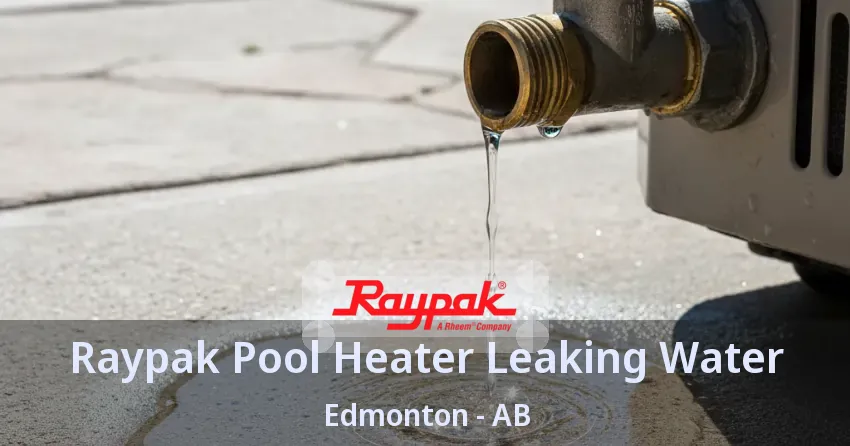
Can a small heater leak explain a pool that keeps losing water?
Sometimes, but not always. A drip at a heater fitting can lose a surprising amount of water over days, yet normal evaporation, splash-out and backwashing often explain a falling water level too. A simple bucket test can help sort it out, and the pattern of loss adds clues: a leak on the pressure side of the pump usually shows up only while the pump runs, and a crack in the heat exchanger may leak only under pressure. Look for wet ground, mineral crust or rust streaks around the equipment pad. Report what you find, including when the water level drops fastest, so the technician knows whether the heater is a suspect or only one of several.
How does a technician find the exact source of a heater leak?
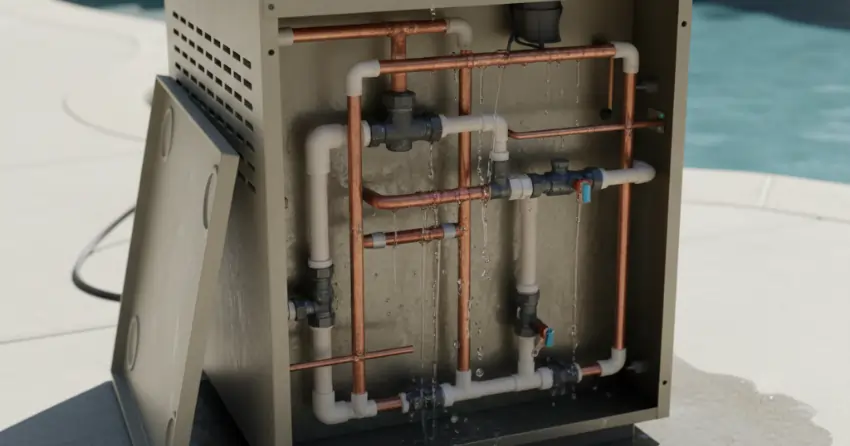
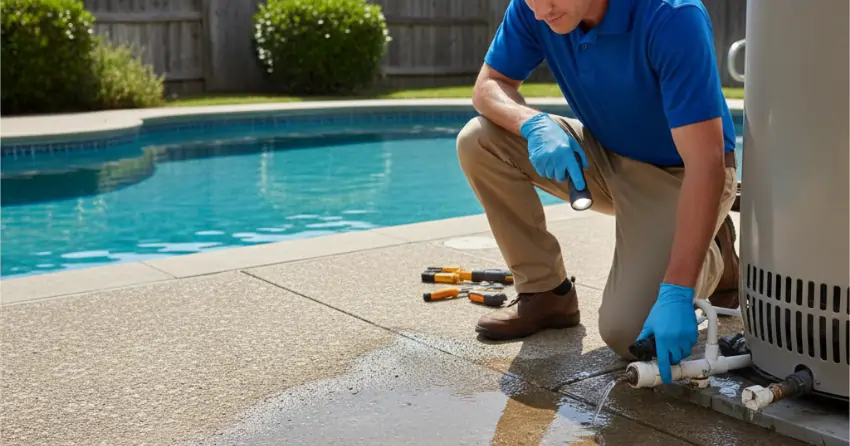
The technician first dries the area so new water stands out, then runs the pump with the heater off and watches where moisture appears. Comparing a dry start with a running pump separates a leak under pressure from condensation. Panels come off to follow the water upward to the header, the tube joints or the plumbing above, and a flashlight and paper towel help trace a slow seep. If the cause is hidden, the water side may be pressure-tested after isolating the heater with its valves. Photographs of the wet spot, taken before and after drying, help explain the findings to you and justify the repair that follows.
How is scale removed from a pool heater heat exchanger?
Scale is a slow problem with a quick give-away: the heater gets noisy and pool temperatures rise more slowly than before. We confirm it by checking the temperature rise, the pressure drop across the unit and, when the headers are off, the look of the tube interior. Cleaning is done with a proper descaling solution circulated in a controlled way, followed by a thorough rinse, because ordinary household acids can harm the metal. Afterward the pool’s calcium hardness, alkalinity and pH deserve testing, or the crust will simply rebuild over the next season.
Can a dirty filter make a pool heater stop working?
Think of the pump and filter as the heater’s support crew. When the filter is overdue for cleaning, pressure builds and flow falls, and the first thing to notice may be a heater that refuses to fire. Variable-speed pumps add another twist: at low speed they may not move enough water to satisfy the heater’s switch, so the schedule needs a minimum heating speed. Pool owners can help by cleaning baskets, backwashing or cleaning cartridges on schedule and telling us about any gauge readings that look different from normal.
What tests are used to find a pool heater fault?
Good diagnosis is mostly elimination. We ask when the problem began, what changed and what the heater does or does not do. Then we measure rather than assume: voltage at the board, continuity through safety switches, water pressure on both sides of the unit, temperature rise across it. The reading that falls outside its expected range points to the faulty link. Replacing a part without a measurement behind it can cost you twice, once for the part and once for the repeat visit when the problem returns.
How much time should you allow for pool heater repair?
The honest answer is that diagnosis takes as long as it takes, and the repair itself is usually the shorter part. We arrive with common igniters, sensors, switches and gaskets, so straightforward faults are often finished before we leave. When the failed item is a control board, an exchanger or a model-specific part, we place the order and schedule a return once it arrives, and we tell you how long we expect to wait. Rushing a repair rarely helps, since a missed cause means a callback. A complete test at the end is part of the job, not an extra.
How can I reduce how long my pool heater runs?
The surest way to shorten run time is to stop heat from escaping. A cover over the pool when it is not in use makes a big difference, as does a windbreak such as a fence or hedge. Set the thermostat to the lowest temperature you will enjoy, and avoid large swings up and down. Heat the pool on a schedule that matches when you swim rather than all day. Keep the heater maintained, because scale and dirty burners waste energy. Even a few degrees of difference in the set point can change energy use noticeably.
What can I check myself when my pool heater stops working?
Think of it as a ladder with only the first rungs open to you. Start with settings and power, move to circulation and then look at the surroundings. Take notes on every step: what you changed, what you saw and what happened. Write down any codes. Resist the urge to open panels, spray cleaners into the burner area or press reset repeatedly. The records you gather will help the technician move straight to the likely cause, often shortening the visit, and they show whether the trouble is constant or comes and goes.
How do you decide between repairing and replacing a pool heater?
The decision rests on a few questions. How old is the heater, and how often has it needed repairs? What failed: an inexpensive part, or the heat exchanger or compressor that makes up much of the unit’s value? Are parts still available? Is it efficient and sized correctly for your pool? A single modest repair on a heater that otherwise runs well is usually sensible. Repeated failures, a leaking exchanger, heavy corrosion or a repair that approaches the cost of a new unit all point toward replacement.
Care for the home your family relies on
The systems that keep a home comfortable tend to work quietly in the background until something goes wrong. A planned visit is a calm way to keep your pool heater in good shape. Request a quote from the Gas Fireplace Edmonton team in Edmonton.
